Hardness and Material Testing
Connect each automotive material test to the component, manufacturing condition, failure mode and decision it is meant to support.
Direct answer
A defensible automotive material-testing program starts with the component decision, not with a list of available machines. Define the material condition and failure mode, select a suitable method, control the specimen and test conditions, verify the equipment, record the result and its limitations, then apply the acceptance rule named by the drawing, material specification, customer requirement or applicable regulation.
A result from one specimen does not by itself prove how the whole component will behave in service. ASTM E8/E8M notes that tensile results from selected portions of a material may not fully represent the end product or its behaviour in different environments. ASTM E18 makes a similar limitation clear for a Rockwell hardness result taken at one location. These are method boundaries, not reasons to discard the tests.
Build the test plan from the decision
Start by writing the decision that the evidence must support. Examples include accepting incoming material, approving a heat-treatment process, releasing a welded component, investigating a failure or validating a design change. The same material may require different evidence for each decision.
| Decision or risk | Possible evidence | Control that must be defined |
|---|---|---|
| Confirm incoming material identity and condition | Supplier certificate, composition result, hardness or tensile result where specified | Material grade, heat or batch, sampling plan and acceptance criterion |
| Assess forming or heat-treatment effects | Hardness profile, tensile properties, metallography or other method selected by engineering | Sample location, orientation, surface preparation and process condition |
| Assess a joint or weld | Procedure qualification evidence, inspection results and destructive tests appropriate to the joint | Joint design, process parameters, sampling location and applicable code or customer requirement |
| Assess repeated loading | Fatigue data supported by a defined loading model and representative specimens | Stress ratio, load form, environment, surface condition and statistical treatment |
| Assess impact or crash-related behaviour | Material impact data plus component or vehicle-level validation | Temperature, loading rate, geometry and the relationship between specimen and service condition |
| Assess corrosion, chemical or thermal exposure | Defined exposure followed by inspection or property testing | Medium, temperature, duration, cycling, preconditioning and post-exposure acceptance rule |
This table is a planning framework, not a universal test schedule. Engineering must select the methods and conditions that match the component, material system, market and applicable requirements.
What common material tests can and cannot establish
Tensile testing
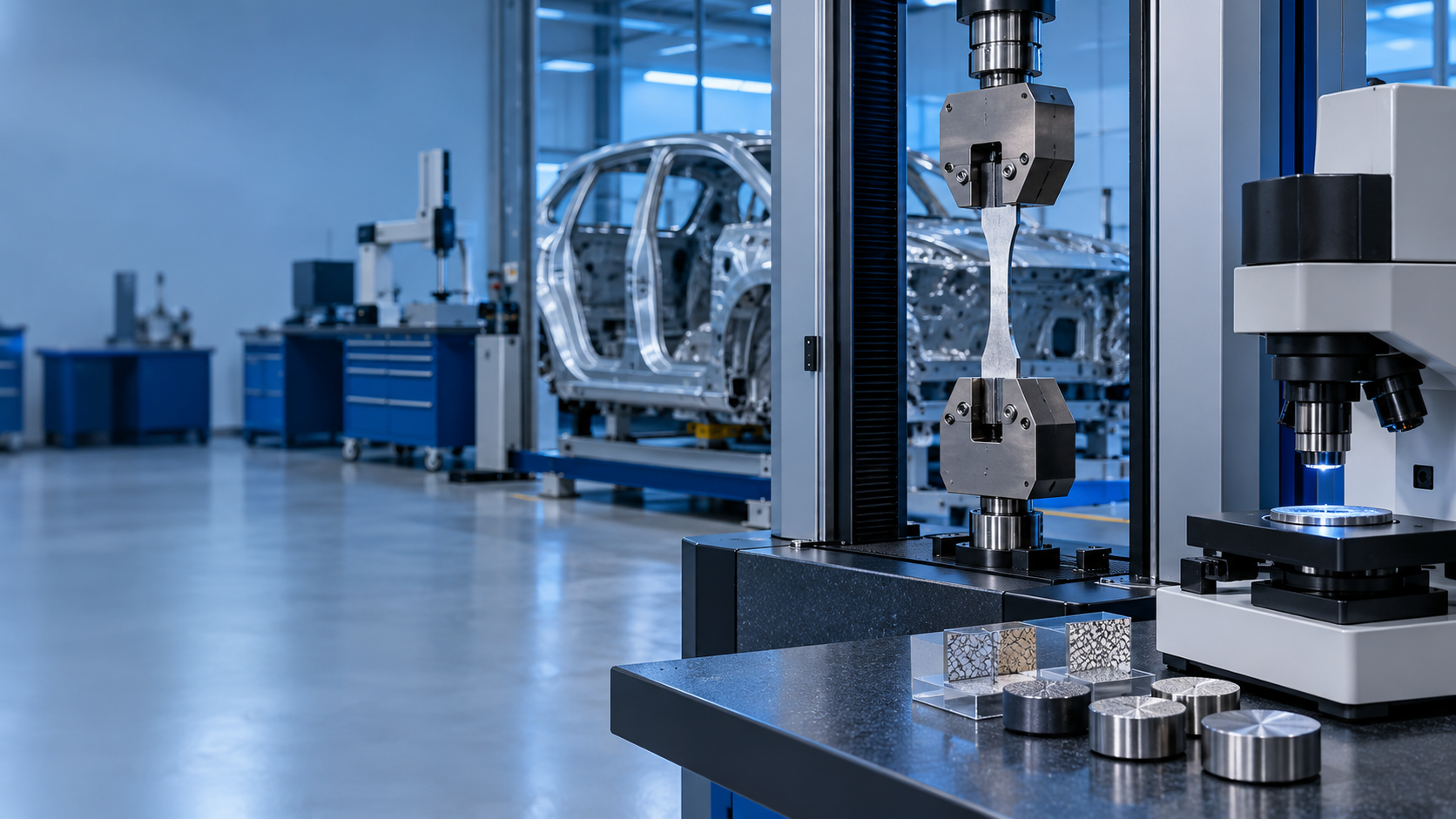
ASTM E8/E8M covers room-temperature tension testing of metallic materials and the determination of properties such as yield strength, tensile strength and elongation. The result depends on specimen geometry, preparation, orientation, test control and reporting. It is useful for material comparison and acceptance when the governing specification calls for it. It is not a complete simulation of a formed part, joint, crash event or service environment.
Rockwell hardness testing
ASTM E18 describes Rockwell and superficial Rockwell hardness testing, including machine verification and method controls. Hardness can support material-condition and process-control decisions, but scale selection, surface condition, part thickness, curvature and test location matter. A hardness value should not be converted into another property unless the applicable relationship is technically justified for that material and condition.
Force-controlled axial fatigue testing
ASTM E466 covers constant-amplitude axial fatigue testing of metallic specimens in a defined regime. Its scope does not cover full-scale components. The standard also states that design use requires realistic simulation of service conditions or a clearly defined method for accounting for them. Surface condition, geometry, material direction and environment therefore belong in the record.
Impact, fracture and component testing
Material impact tests can reveal behaviour that a slow tensile test does not show, but the selected method, notch, orientation, temperature and loading condition determine what the result means. Component and vehicle-level tests remain necessary when material coupons cannot reproduce the relevant geometry, joints, load paths or containment function.
Connect laboratory results with production evidence
Laboratory data becomes more useful when it can be traced to the manufactured condition. Link the result to the material batch, supplier, process route, heat-treatment state, forming or joining operation, sample location and part revision. Preserve any deviation from the specified method.
Production monitoring can identify changes in process variables or measurement trends. It should not be described as proof of a material property unless the relationship has been established and remains controlled. When a surrogate measurement is used, document the correlation study, applicable range, review frequency and action limit.
EV battery enclosure evidence
For an EV battery enclosure, material data is only one layer of the evidence. The enclosure may also depend on joints, seals, coatings, fasteners, dimensional control and electrical or thermal interfaces. A test plan should connect material properties with these features and with the relevant component and vehicle validation.
Requirements vary by jurisdiction and vehicle category. As one United States example, NHTSA's FMVSS No. 305 test procedure addresses electrolyte spillage, propulsion-battery retention and electrical isolation during specified crash tests. It is a vehicle-level regulatory example, not a universal material test or a global requirement.
Supplier and laboratory records to request
- Material grade, specification, heat or batch and condition.
- Sample location, orientation, preparation and identification.
- Test method and edition, including approved deviations.
- Equipment identification, verification or calibration status and relevant reference materials.
- Test environment and method-specific settings.
- Individual results, units, corrections and stated uncertainty where it is relevant to the decision.
- The acceptance criterion, its source and any decision rule used.
- Identification of invalid, repeated or excluded tests and the reason for each action.
- Approval, revision and data-retention records.
ISO/IEC 17025 accreditation can support confidence in a laboratory's competence, but the current scope still needs to cover the specific test, range and method required. Accreditation is not a blanket statement that every service offered by a laboratory is accredited.
Using analytics and AI without weakening traceability
Analytics can help identify drift, group similar failure records or prioritize investigations. A model output is an inference from data, not a material test result. Keep the original measurements, data-selection rules, model version, validation record and human decision. Check whether changes in material, supplier, equipment or process have moved the new data outside the conditions used to validate the model.
Do not replace a required test or acceptance decision with a prediction unless the responsible engineering and compliance process has established that use. Claims about reduced cost, shorter testing or lower failure rates require real, auditable project data.
Engineering review checklist
- State the component decision and the failure mode being addressed.
- Identify the document that owns the acceptance criterion.
- Confirm that each test method fits the material, specimen and condition.
- Check equipment verification, calibration and reference-material status.
- Trace every result to the batch, process state and sample location.
- Record uncertainty or other result limitations where they affect the decision.
- Connect coupon evidence to joint, component and system validation.
- Preserve deviations, exclusions and engineering approvals.
Comments
Post a Comment