Automotive and EV Testing
Plan EV battery enclosure validation around leak integrity, weld quality, corrosion, vibration, mechanical loads, thermal conditions, and traceable evidence.
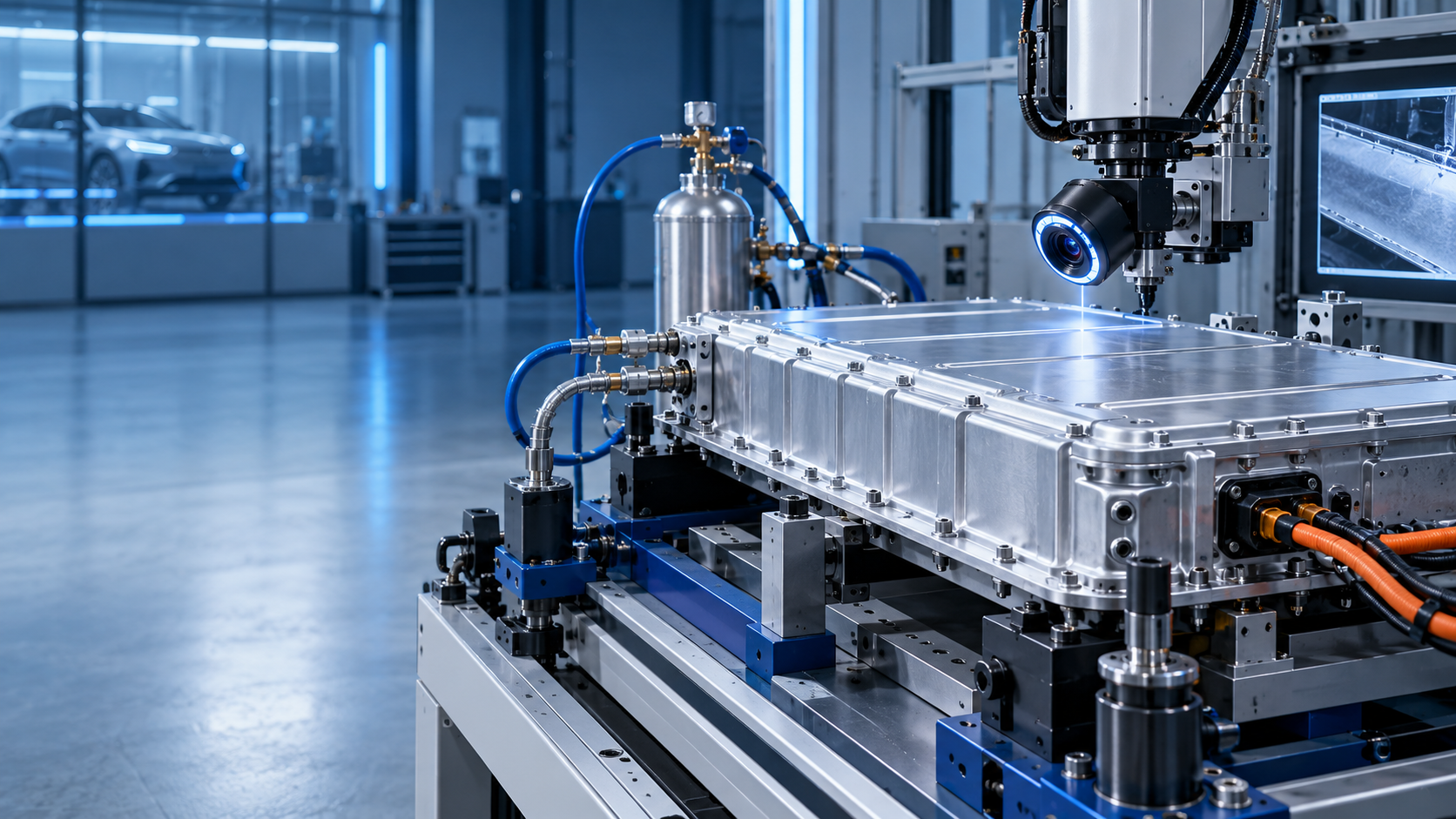
EV Battery Enclosure Testing: Leak, Weld, Corrosion, Crash, and Thermal Validation
EV Manufacturing • Battery Validation • Quality Engineering
Even though an EV battery enclosure appears to be in good condition, it may include a flaw that is not visible to the human eye. Corrosion can weaken joints, dimensional errors can impact sealing, weld defects can develop into fatigue cracks, and repeated vibration can transform a minor manufacturing flaw into a durability issue.
That is why EV battery enclosure testing is not just one inspection. Dimensional inspection, weld assessment, leak testing, environmental exposure, corrosion testing, vibration and fatigue testing, impact or crash validation, and temperature evaluation are all necessary for reliable validation.
Proving an enclosure passes a single test is not the only goal. Understanding how the enclosure may fail, choosing the right control for each mode of failure, and relating measurement findings to production choices are the goals.
Why EV Battery Enclosure Testing Is Critical
A battery enclosure may come into contact with vibration, water, dust, road debris, temperature fluctuations, and mechanical stresses while the vehicle is operating. Throughout the vehicle's service life, these factors may function separately or in concert.
Therefore, rather than relying just on one inspection method, a successful validation approach should be built on failure types.
A useful validation sequence is
Dimensional Integrity → Weld Integrity → Sealing → Environmental Durability → Structural Durability → Thermal Validation
The enclosure design, materials, manufacturing process, vehicle application, and any relevant customer, regulatory, or technical standards determine the precise order and acceptance requirements.
Core EV Battery Enclosure Tests
| Test | Main Purpose | Typical Failure Detected |
|---|---|---|
| Dimensional inspection | Verify geometry and critical interfaces.. | Warping, distortion,, and tolerance errors |
| Weld inspection | Evaluate joint integrity.. | Cracks, porosity,, and incomplete weld conditions |
| Leak testing | Verify enclosure tightness against the specified requirement.. | Leaks and sealing defects |
| Environmental testing | Evaluate response to environmental exposure.. | Ingress, degradation,, and environmental failures |
| Corrosion testing | Evaluate environmental durability.. | Coating and corrosion-related degradation |
| Vibration and fatigue testing | Evaluate repeated mechanical loading.. | Cracking, joint and attachment failures |
| Impact and crash validation | Evaluate structural protection under relevant loads.. | Deformation, penetration,, and loss of protection |
| Thermal validation | Evaluate temperature behavior and thermal interfaces. | Thermal-management and thermal-stress problems |
1. Dimensional Inspection
Because the enclosure must properly connect with other battery and vehicle components, dimensional inspection is a crucial early check.
Important characteristics can include:
- Overall length, width, and height
- Flatness
- Mounting-hole position
- Sealing-surface profile
- Bracket location
- Critical datum relationships
- Wall thickness where applicable
- Critical assembly interfaces
Manufacturers may employ coordinate measuring machines (CMMs), optical measurement systems, laser scanning, or other suitable metrology equipment, depending on the geometry and tolerance requirements.
The important principle is that the measurement method should be selected according to the geometry, tolerance, accessibility, and measurement requirement rather than simply choosing the most sophisticated instrument available.
Beyond the enclosure itself, a dimensional issue may have implications. Sealing surfaces, mounting alignment, module installation, and downstream assembly can all be impacted by distortion.
2. Weld Quality Testing
For both structural and, depending on the design, sealing performance, many battery enclosures rely on welded connections. As a result, the material, welding technique, joint design, and relevant specification must all be taken into account when evaluating the quality of the weld.
Potential controls include:
- Visual inspection
- Weld-parameter monitoring
- Dimensional inspection around welded areas
- Non-destructive testing where appropriate
- Destructive testing during process qualification or validation
- Process capability and production monitoring
The joint, material, welding procedure, defect risk, and necessary degree of confidence all influence the best inspection technique. All aspects of weld integrity cannot be determined by a visual evaluation alone.
3. Leak Testing
Where the enclosure has specific requirements for protection against environmental infiltration or where leakage might impact internal components, leak testing is very crucial.
Depending on the design and production requirement, manufacturers may use methods such as pressure decay, vacuum decay, tracer-gas testing, or other suitable leak-detection techniques.
The goal is to ascertain if the finished enclosure consistently satisfies the specified leakage criterion.
Important limitation:
It is not appropriate to use a leak test in place of dimensional, structural, corrosion, vibration, or crash validation. It is possible for a component to meet a leakage criterion and yet have a substantial failure mode.
4. Ingress and Environmental Testing
Environmental validation evaluates how the enclosure responds to conditions representative of its intended vehicle environment.
Depending on the application, the validation program may consider:
- Water exposure
- Dust exposure
- Temperature cycling
- Humidity
- Salt and corrosive environments
- Combined environmental loads
The actual enclosure design and its intended working circumstances should be linked to environmental testing. Instead of presuming that a single general environmental test applies to all vehicle applications, requirements should be determined from the relevant technical, customer, and regulatory standards.
5. Corrosion Testing
Because the enclosure may be exposed to moisture, pollutants, road salt, and other environmental factors, corrosion prevention is particularly crucial for parts found beneath a car.
The entire material system, not just the coating, should be taken into account in a corrosion-validation procedure. Relevant elements may consist of:
- Base material
- Protective coatings
- Welded joints
- Fasteners
- Drainage design
- Seams and interfaces
- Contact between dissimilar materials
When they are suitable for the material system and validation goal, salt spray and other environmental tests can be helpful parts of a larger durability program.
6. Vibration and Fatigue Testing
During vehicle operation, a battery container is subjected to repetitive mechanical stress. Long-term fatigue durability is not always demonstrated by passing a static load measurement.
Vibration and durability testing can evaluate areas such as
- Welded joints
- Mounting brackets
- Fasteners
- Enclosure panels
- Cooling-system interfaces
- Structural attachment points
A useful way to understand the mechanism is
Repeated Load → Vibration Response → Stress Concentration → Fatigue Damage → Durability Failure
This is another reason why little differences in production might be significant. When exposed to thousands or millions of repeated load cycles, a local geometric aberration or weld flaw may respond differently than it does during a brief examination.
7. Impact and Crash Validation
Under pertinent mechanical stresses, the enclosure must offer the necessary degree of structural protection for the battery system. Understanding deformation and load routes may be aided by both engineering simulation and physical testing.
Important questions include:
- Does the enclosure maintain the required structural integrity?
- Does deformation reach battery modules or other protected components?
- Can an impact damage cooling-system components?
- Could deformation compromise electrical isolation or other safety functions?
- Does the design provide the required protection against relevant underbody hazards?
Application-specific crash and impact criteria apply. Therefore, rather than interpreting a single generic impact test as universal, validation should be based on the relevant vehicle and battery system needs.
8. Thermal Validation
Battery enclosures have direct interaction with surrounding vehicle components, structural interfaces, and thermal management systems. Therefore, both temperature behavior and the mechanical effects of frequent temperature fluctuations should be taken into account during thermal validation.
Depending on the design, evaluation may consider:
- Temperature distribution
- Thermal-management interfaces
- Cooling performance
- Thermal cycling
- Expansion and contraction
- Thermally induced mechanical stress
Joints, seals, fasteners, and other enclosure interfaces may be affected by expansion and contraction brought on by frequent temperature variations. Therefore, rather than being a stand-alone task, thermal validation should be taken into account in conjunction with mechanical and environmental durability.
9. Why One Test Cannot Prove Enclosure Reliability
This is one of the most important principles in battery-enclosure validation.
Consider an enclosure that passes the leak test. While the result indicates the enclosure's sealing effectiveness, it does not guaranty proper installation geometry.
A dimensionally precise enclosure does not guarantee that all welds are satisfactory. A weld that passes inspection does not always show long-term fatigue durability. Vibration-tested components do not guarantee corrosion resistance or crash performance.
Each test answers a particular engineering question.
Therefore, the stronger strategy is
Failure Mode → Appropriate Test → Measurement Result → Process Decision → Corrective Action
10. Connecting Tests to Failure Modes
| Failure Risk | Primary Control | Additional Control |
|---|---|---|
| Water or environmental ingress | Leak testing | Environmental validation |
| Weld defect | Weld inspection | Process monitoring and qualification |
| Dimensional distortion | CMM or optical inspection | Process capability monitoring |
| Corrosion | Environmental/corrosion testing | Coating and material-system inspection |
| Fatigue damage | Vibration and durability testing | Structural analysis and process controls |
| Impact deformation | Impact or crash validation | Engineering simulation |
| Thermal stress | Thermal cycling and validation | Temperature mapping and structural analysis |
11. Why Measurement Traceability Matters
In high-volume EV manufacturing, inspection data is more valuable when it can be tracked back to individual components, batches, processes, or manufacturing stations.
Without traceability, a failed enclosure may remain an isolated incident. Traceability helps quality engineers identify trends.
- Identify the enclosure or production batch.
- Link inspection results to the relevant manufacturing process or station.
- Maintain records of critical dimensional measurements.
- Track relevant welding and assembly-process information.
- Connect failures with corrective-action investigations.
- Monitor trends rather than relying only on individual pass/fail results.
Inspection now serves as a source of information about the manufacturing process rather than just a gate at the end of production.
12. From Testing to Predictive Quality
The ultimate goal of an efficient quality system isn't just to find faulty enclosures. Its goal is to detect process drift early enough to prevent faults from propagating downstream.
A simplified quality-feedback loop looks like this:
Measurement Trend → Process Drift → Corrective Action → Reduced Defects → Lower Rework → Lower Warranty Exposure
If dimensional measurements approach a tolerance limit, the quality team may evaluate the production process before a substantial number of components fail to meet standards.
This idea applies to data from weld processes, leak tests, corrosion observations, and durability measurements.
13. Practical EV Battery Enclosure Testing Checklist
- Identify critical enclosure characteristics and interfaces.
- Define dimensional inspection requirements.
- Establish weld inspection and process-control requirements.
- Define the appropriate leak-testing method and acceptance requirement.
- Evaluate water, dust, and other environmental exposures where applicable.
- Establish corrosion-validation requirements.
- Evaluate vibration and fatigue performance.
- Validate impact and crash performance where required.
- Evaluate thermal behavior and thermal cycling.
- Maintain measurement and inspection traceability.
- Connect test results to specific failure modes.
- Use inspection trends to support process improvement and corrective action.
14. The Bigger Picture: Testing Is Part of the Manufacturing System
It is tempting to think of battery-enclosure testing as a final quality checkpoint. In modern EV manufacturing, that approach is too narrow.
Dimensional measurements can detect process drift. Weld inspection can detect faults with the joining process. Leak testing can reveal sealing flaws. Environmental and corrosion testing can identify flaws in material systems. Vibration tests can reveal fatigue processes. Thermal testing can reveal issues caused by frequent temperature fluctuations.
When these results are connected, testing becomes more than a pass-or-fail operation. It becomes a feedback mechanism for manufacturing quality.
Frequently Asked Questions
What should be tested first on an EV battery enclosure?
Start by identifying the enclosure's important qualities, intended functions, and likely failure mechanisms. Validation sequences for dimensional, weld, and sealing controls vary based on design and needs.
Is leak testing enough to validate an EV battery enclosure?
No, leak testing examines a specific sealing or leaking requirement. It does not automatically show dimensional correctness, structural durability, corrosion resistance, vibration durability, or crash performance.
Why is dimensional inspection important?
Dimensional variations can have an impact on mounting, sealing, module installation, and downstream assembly. Early measurement can reveal nonconforming components and process drift before they affect later manufacturing stages.
Which instruments can be used for battery enclosure dimensional inspection?
Manufacturers may utilize CMMs, optical measurement systems, laser scanners, or other metrology equipment to meet geometry, tolerance, and inspection requirements. When selecting an instrument, consider the measuring job, not only its complexity.
Why combine multiple battery enclosure tests?
Different experiments reveal various failure mechanisms. A leak test cannot determine fatigue durability, and dimensional examination cannot determine crash performance. Combining relevant tests leads to a more thorough validation technique.
How does traceability improve battery enclosure quality?
Traceability permits inspection and testing findings to be linked to individual components, batches, processes, or manufacturing stations. This can aid quality teams in identifying recurrent trends and investigating process drift, rather than considering each failure as a singular incident.
Document the decision.
Validation of EV battery enclosures is a multidimensional technical issue. Dimensional metrology, weld inspection, leak testing, environmental validation, corrosion testing, vibration and fatigue testing, impact validation, and thermal assessment all address various aspects of enclosure performance.
No single inspection can establish complete enclosure reliability.
A more effective strategy is to assign a validation technique to each major failure mode and use the results to inform production decisions.
Using testing data as process intelligence may transform battery-enclosure quality into a continuous improvement system rather than a one-time pass-or-fail decision.
Note: Test methodologies, acceptance criteria, and validation sequences should align with vehicle, battery system, customer, regulatory, and technical requirements. This article offers a technical foundation and should not be used as a replacement for the relevant specification.
Comments
Post a Comment