Automotive and EV Testing
Connect EV battery enclosure failures with rework, downtime, validation gaps, product risk, and the evidence needed for corrective action.
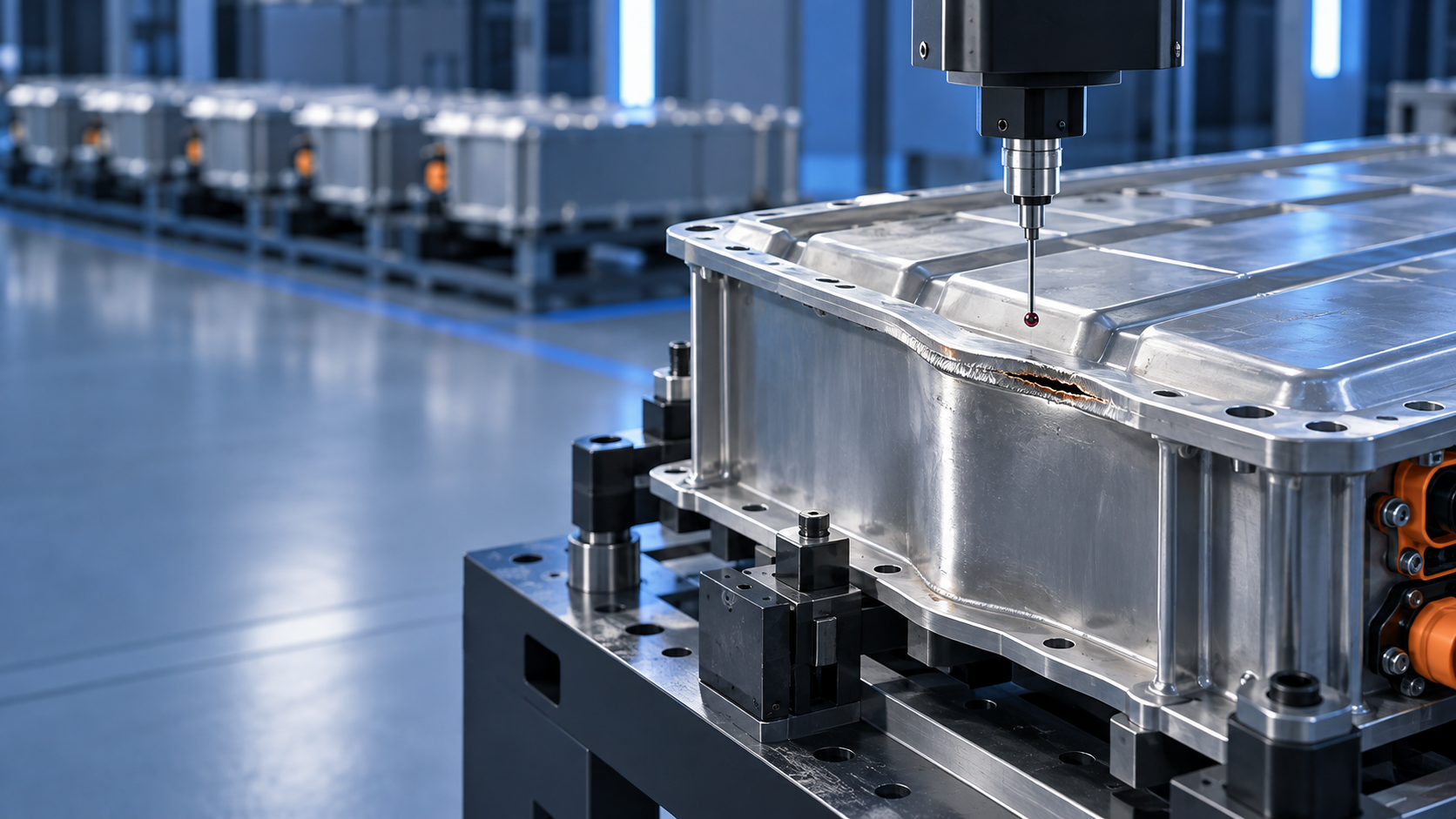
How enclosure failures create manufacturing cost and risk
EV battery enclosures are no longer simple protective boxes. They are structural, thermal, electrical, and environmental protection systems that must survive vibration, impact, water, corrosion, temperature cycling, and long-term vehicle operation.
Supporting Topics: battery enclosure quality, EV battery enclosure defects, battery pack manufacturing, enclosure welding defects, water ingress, corrosion, dimensional inspection, and battery enclosure testing.
Why Battery Enclosure Quality Matters
An EV battery enclosure typically protects battery modules and cells from mechanical impact, moisture, contamination, and environmental exposure. It may also integrate cooling components, electrical interfaces, structural mounting points, and sealing systems.
This makes enclosure quality a multidisciplinary manufacturing problem involving:
- Sheet-metal forming or casting
- Aluminum or steel joining
- Laser or conventional welding
- Dimensional control
- Gasket and sealing systems
- Corrosion protection
- Thermal management
- Crash and impact protection
- High-voltage electrical isolation
- Vibration and fatigue resistance
How a Small Manufacturing Defect Becomes a Large Financial Problem
When an enclosure defect is discovered during manufacturing, the cost may be limited to inspection and rework. When the same defect reaches an assembled battery pack or a vehicle already in the field, the financial exposure can increase dramatically.
The economic impact can be understood as a failure chain:
The earlier the defect is detected, the easier it generally is to contain.
| Detection Stage | Typical Response | Potential Cost Exposure |
|---|---|---|
| Incoming/process inspection | Reject or rework the enclosure. | Low |
| End-of-line testing | Pack disassembly and rework | Moderate |
| Vehicle assembly | Production interruption and rework | High |
| Dealer/service discovery | Vehicle repair or battery replacement | Very high |
| Safety-related field defect | Recall, inspection, and corrective action | Potentially millions |
10 Major EV Battery Enclosure Failure Risks
1. Weld Porosity and Incomplete Penetration
Welded aluminum and steel enclosures can develop porosity, incomplete penetration, cracking, or distortion. These defects may reduce structural strength or compromise sealing.
2. Weld Distortion
Heat generated during welding can distort enclosure panels. Excessive dimensional variation can create problems during battery-module installation or gasket compression.
Dimensional inspection can therefore be important after welding, particularly around mounting interfaces, sealing surfaces, and critical datum locations.
3. Seal and Gasket Failure
A battery enclosure can meet dimensional specifications but still fail its environmental protection requirements if the sealing system is damaged, incorrectly compressed, or poorly assembled.
Potential causes include damaged gaskets, incorrect seating, uneven compression, surface contamination, and enclosure distortion.
4. Water and Dust Ingress
Ingress can contribute to corrosion, insulation degradation, and electrical problems. For this reason, enclosure sealing and leak testing are critical manufacturing controls.
5. Corrosion
Battery enclosures operate underneath vehicles and may encounter water, road salt, mud, and temperature cycling. Material selection, coating, and isolation between dissimilar metals are therefore important.
Corrosion control should consider both the enclosure material and the interfaces between different materials, fasteners, coatings, and joints.
6. Underbody Impact
Road debris or severe underbody impacts can deform the enclosure. Excessive deformation may affect battery-module clearance, cooling components, seals, mounting points, or electrical interfaces.
7. Dimensional Variation
Forming, casting, machining, and welding processes can introduce dimensional variation. A small deviation at a critical interface can create assembly problems even when the overall enclosure appears visually acceptable.
| Dimensional Area | Potential Consequence |
|---|---|
| Mounting-hole location | Assembly difficulty or misalignment |
| Sealing-surface flatness | Uneven gasket compression |
| Panel profile | Clearance or fit problems |
| Datum relationship | Downstream assembly variation |
| Overall enclosure dimensions | Vehicle-pack integration problems |
8. Fastener and Joint Problems
Fasteners and structural joints can influence enclosure integrity. Incorrect torque, damaged threads, poor seating, or variation in joint assembly can create mechanical and sealing problems.
9. Vibration and Fatigue
An enclosure is exposed to continuous vibration during vehicle operation. Repeated loading can contribute to fatigue at welds, brackets, mounting points, and other stress-concentration locations.
10. Thermal and Environmental Cycling
Battery systems experience changes in temperature during operation, charging, and environmental exposure. Repeated thermal expansion and contraction can place additional demands on materials, joints, seals, and coatings.
Where Inspection and Measurement Fit Into the Quality Strategy
Battery enclosure quality is not controlled by one inspection station. A robust strategy places controls at multiple stages of the manufacturing process.
| Manufacturing Stage | Potential Quality Control |
|---|---|
| Incoming material | Material identification, dimensional and surface checks |
| Forming/casting | Dimensional inspection and defect detection |
| Welding | Visual and appropriate weld inspection |
| Post-weld | Dimensional verification and distortion assessment |
| Sealing | Gasket and sealing-surface inspection |
| Ingress protection | Appropriate leak or ingress testing |
| Assembly | Fit, fastener, and interface verification |
| End of line | Functional and safety-related validation as applicable |
Why Dimensional Calibration Matters in Battery Enclosure Manufacturing
Inspection equipment is only useful when its measurement capability can be trusted. Vernier calipers, micrometers, height gauges, CMMs, gauges, and other dimensional instruments can be used to verify enclosure features.
Calibration provides documented evidence of the relationship between an instrument's indication and suitable reference standards under defined conditions.
- ☐ Verify the measuring instrument is within its calibration interval.
- ☐ Confirm the instrument range is suitable for the feature being inspected.
- ☐ Use appropriate reference standards.
- ☐ Maintain traceability of measurement results.
- ☐ Consider measurement uncertainty where tolerances are critical.
- ☐ Record inspection results against the applicable drawing or specification.
Measurement Uncertainty and Inspection Decisions
For critical enclosure dimensions, the question is not simply whether the instrument displays a value with a particular number of decimal places. The measurement system must be suitable for the tolerance and decision being made.
Potential contributors to measurement uncertainty can include:
- Instrument resolution
- Calibration uncertainty
- Repeatability
- Temperature
- Operator influence
- Alignment
- Fixture effects
- Reference-standard uncertainty
Failure Detection: Early vs. Late
The most useful quality strategy is to detect and contain defects before they propagate into higher-value assemblies and field populations.
| Control Point | What Can Be Contained | Why It Matters |
|---|---|---|
| Process inspection | Welding, forming, and dimensional variation | Prevents defective enclosures from moving downstream |
| Assembly inspection | Fit, gasket, and interface problems | Prevents pack-level problems |
| End-of-line validation | Pack-level functional issues | Reduces risk before vehicle release |
| Field monitoring | Escaped defects | Can trigger corrective action but generally carries greater cost |
How Manufacturers Can Reduce EV Battery Enclosure Failure Risk
- ☐ Define critical enclosure characteristics.
- ☐ Identify high-risk weld locations.
- ☐ Control welding parameters and joining processes.
- ☐ Inspect critical dimensions after forming and welding.
- ☐ Control sealing surfaces and gasket installation.
- ☐ Verify appropriate ingress protection.
- ☐ Control corrosion protection and dissimilar-material interfaces.
- ☐ Verify critical fasteners and joints.
- ☐ Maintain calibrated inspection equipment.
- ☐ Evaluate measurement uncertainty for critical decisions.
- ☐ Use traceable measurement standards where required.
- ☐ Monitor recurring defects and perform root-cause analysis.
Common Manufacturing Questions
Document the decision.
EV battery enclosure failures are rarely just enclosure problems. A weld defect, dimensional deviation, sealing failure, or corrosion issue can propagate through battery-pack assembly and vehicle production before becoming visible as a field problem.
The strongest manufacturing strategy is therefore to detect and contain defects as early as possible. That requires coordinated control of welding, dimensional accuracy, sealing, corrosion protection, impact resistance, vibration performance, and environmental protection.
For manufacturers, the objective should not simply be to find defects. It should be to prevent defects from progressing to the next stage, where the technical and financial consequences become much larger.
Technical Review Note
This article is an educational manufacturing-quality guide. Specific EV battery enclosure requirements depend on vehicle design, battery architecture, materials, manufacturing processes, applicable standards, customer specifications, and validation plans. Inspection and testing methods should therefore be selected according to the applicable engineering requirements rather than treated as a universal checklist.
Comments
Post a Comment